
7.1 vs. 7.2 Surround Sound in Home Theater
The primary difference between 7.1 and 7.2 surround sound systems lies in the number of subwoofers. A 7.1 system includes seven speakers and one subwoofer, while a 7.2 system has seven speakers and two subwoofers.
The additional subwoofer in a 7.2 system provides clearer and more even bass distribution throughout the room, reducing bass peaks and nulls caused by room acoustics.
As an affiliate, I may collect a share of sales or other compensation from the links on this page.
7.1 vs 7.2 Comparison Table

| Feature | 7.1 Surround Sound | 7.2 Surround Sound |
|---|---|---|
| Number of Speakers | 7 (Front Left, Front Right, Center, Surround Left, Surround Right, Rear Left, Rear Right) | 7 (Same as 7.1) |
| Number of Subwoofers | 1 | 2 |
| Bass Distribution | Less even, with potential peaks and dips | More even, with smoother bass response |
| Ideal Room Size | Large spaces | Large spaces |
| Sound Quality | High-quality surround sound, but with uneven bass | Enhanced sound with more balanced and fuller bass |
| Cost | Generally lower | Higher (due to the additional subwoofer) |
| Supported Formats | Dolby TrueHD, DTS-HD Master Audio, Dolby Pro Logic IIx, Dolby Digital Plus, DTS-HD | Same as 7.1 |
| Typical Use Cases | Most home theaters, moderate to large rooms | High-end home theaters, larger rooms with challenging acoustics |
| Supported Devices | PS3, PS4, PS5, Xbox One, Xbox Series X, Nintendo Switch, HD DVDs, Blu-ray players | PS3, PS4, PS5, Xbox One, Xbox Series X, Nintendo Switch, HD DVDs, Blu-ray players |
In summary, a 7.1 system is ideal for most home theaters, providing immersive surround sound with one subwoofer, while a 7.2 system offers an enhanced audio experience with deeper bass effects and more balanced sound quality due to the extra subwoofer.
If you’re undecided about what system to pick for your home theater, this article will be a great guide. We’ll explain what these numbers mean, the pros and cons of each system, and highlight their key features. Let’s dive right in.
Also read: 5.1 vs 5.2 Surround Sound Comparison
What is 7.1?
According to the naming system used with home theaters, the first digit stands for the number of standard speaker channels included in the set. These speakers handle mid-frequency and high-frequency signals from the television.
In this case, 7.1 means there are seven speakers that make up the surround sound layout. These are:
- Center
- Front right
- Front left
- Surround left
- Surround right
- Rare left
- Rare right
For a better visual representation of these speakers, check out this short video:
The second digit, “.1,” refers to the number of subwoofers, which is simply one in this setup.
A good example of a 7.1 surround sound system is the Panasonic SC-BT203 7.1 Surround System (Amazon link).
So what about the 7.2?
What is 7.2?
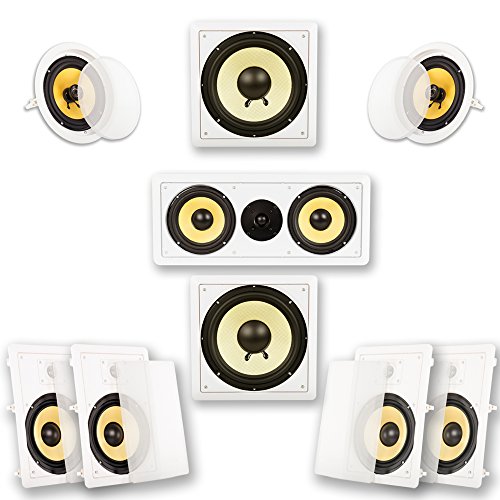
“7” means there are seven basic speakers, while “.2” means the surround sound has two subwoofers instead of 1. The extra sub helps to even out the bass sounds and generally increase overall sound output.
One example of this system is the Acoustic Audio HD728 7.2 Surround System (Amazon link).
7.1 vs. 7.2 Receivers
A receiver acts as the hub of a home theater. Even if this device appears plain and non-attractive, it carries a lot of responsibilities that determine the final sound quality you get from your setup.
Audio/ visual (AV) receivers collect video and audio signals from the sources and direct them to the TV screen and speaker channels respectively so you can watch and listen to films, music, videos, and games seamlessly.
Pros and Cons of 7.1 vs. 7.2 Receivers
| 7.1 receiver | 7.2 receiver | |
|---|---|---|
| Advantages | -Multiple channels outputs -Great for large spaces -More overall sound | -Multiple speaker channels plus an extra subwoofer output -Great for large spaces -Even and smoother bass effects -The subwoofers cannot be localized |
| Disadvantages | -Few sources support this configuration -Uneven low-frequency responses -Subwoofer localization -Large space requirement | -Fewer sources support the configuration -Large space requirement |
Speaker Positioning for 7.1 and 7.2 Setup
Speaker Placement for 7.1 Setup
- Rear speakers: Directly behind the listener.
- Front center: Directly in front of the listener on the front row.
- Front right and left: At an angle of 30° from the listener’s position.
- Surround right and left: Positioned at an angle of 110° from the listening position on the sides.
Subwoofer Placement for 7.1 and 7.2 Setup
For a single subwoofer (7.1 setup), begin by trying common positions like near the center channel speaker or at a corner. If these locations do not provide optimal bass response, perform the “subwoofer crawl”:
- Place the subwoofer at the listening position (e.g., on top of your couch).
- Play a familiar song with bass-heavy audio.
- Crawl around the room listening for the best low-frequency effect.
- Place the subwoofer in that spot.
Here are the steps:
For a dual-subwoofer setup (7.2 system), adding a second subwoofer helps to fill in the uneven bass spots in your room, resulting in a more uniform booming effect felt at multiple listening spots.
Conclusion
If you are looking to purchase a home theatre and want a setup that can produce an impressive surround sound experience, then choosing between 7.1 and 7.2 is your best bet.
The main difference between these two setups is the number of subwoofers. 7.2 has dual subwoofers, while 7.1 offers the traditional single subwoofer. This brings out one of the differentiating qualities of the two. 7.2 enables a more even bass surround sound compared to 7.1. But there are also a few other features you will want to look at before you settle on one of these home theaters.
Once you’ve got your home entertainment system, ensure you position the components correctly, especially the speakers and subwoofers, in order to experience their optimal sound effects.
Also read: 2.1 vs. 5.1 vs. 7.1 Surround Sound